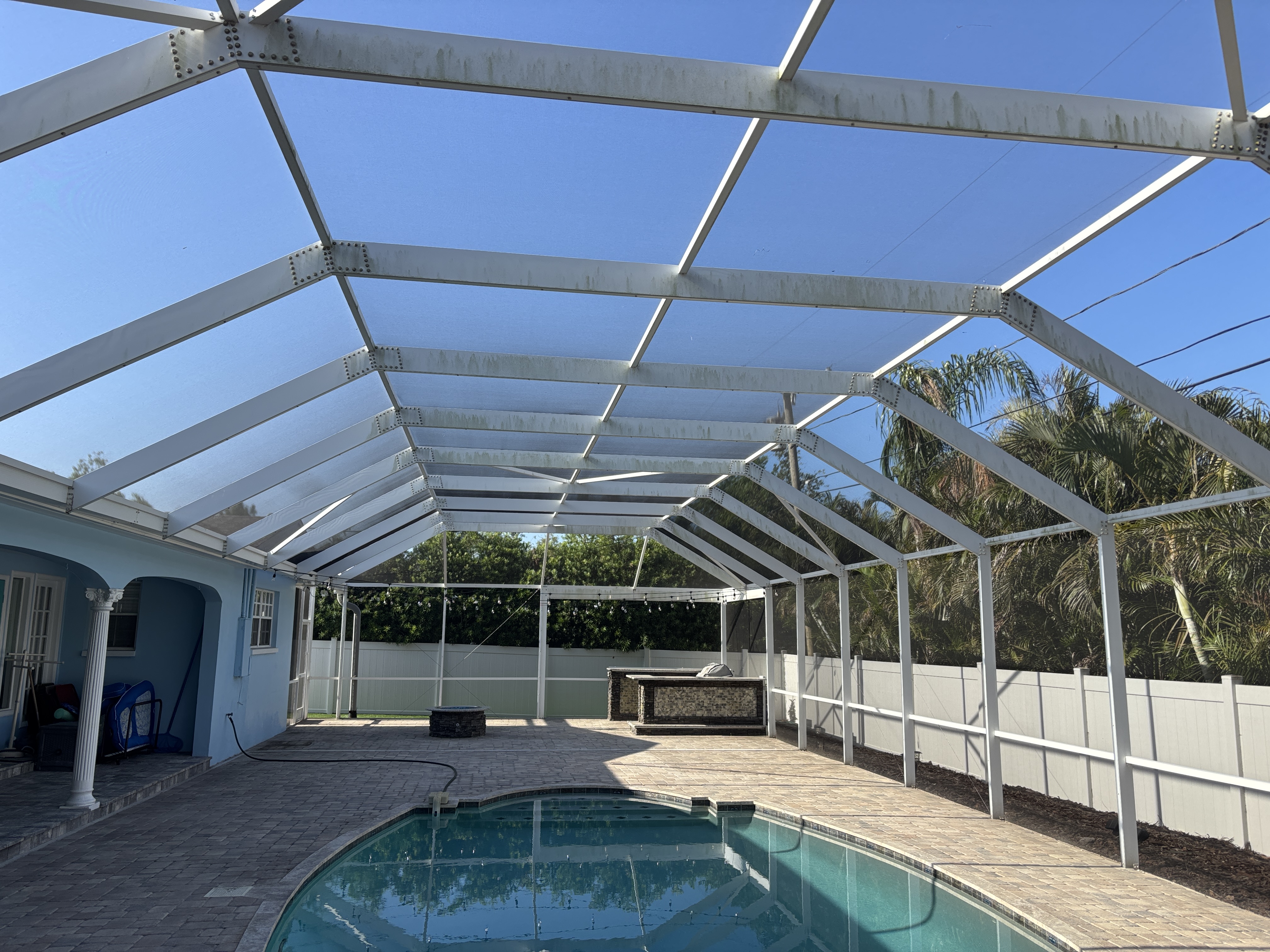
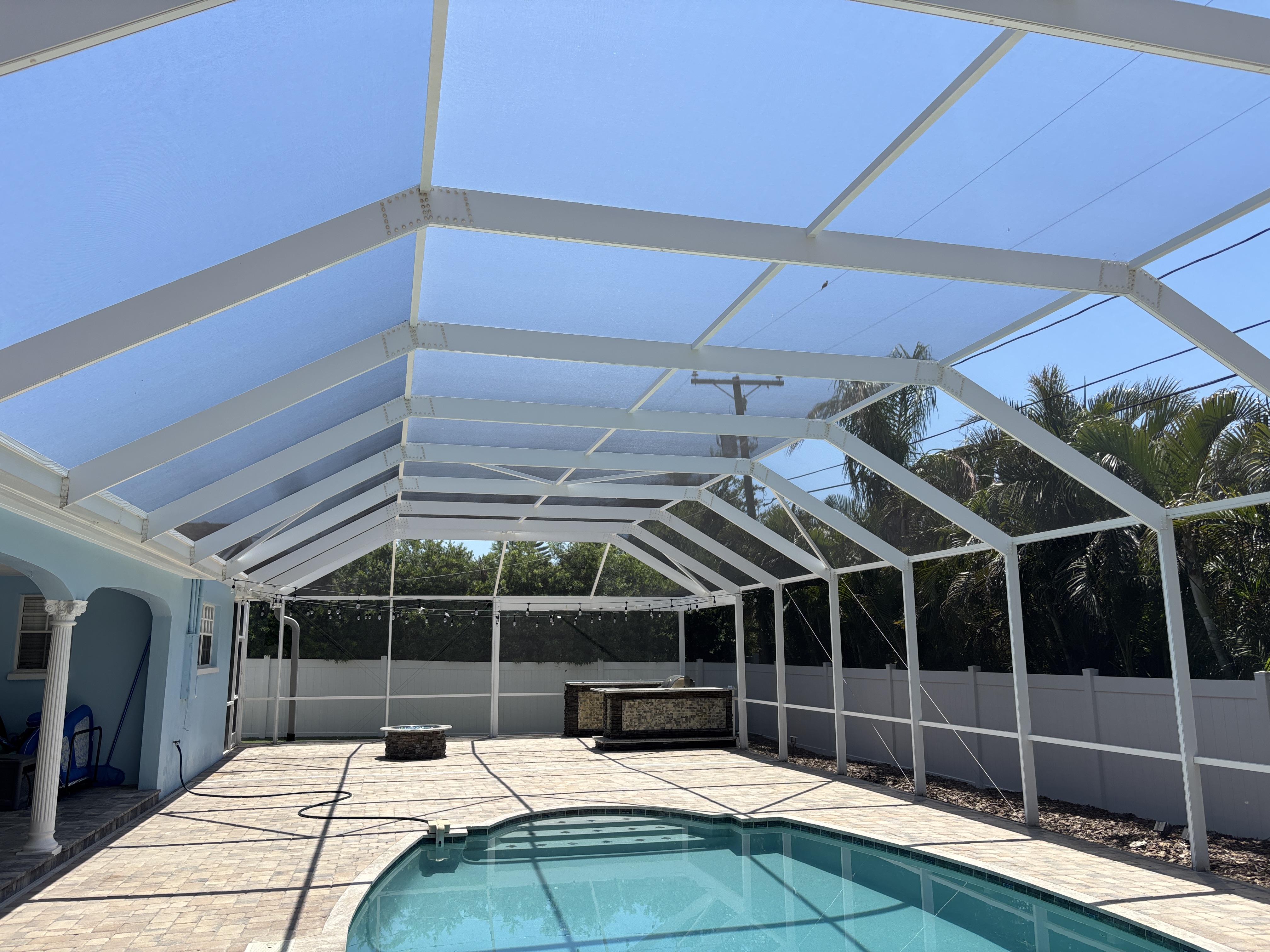
Rusty's Pro Wash & Seal cleans pool cages, screen enclosures, lanais, and pool decks throughout Greater Tampa Bay. Florida's subtropical climate is one of the most demanding environments for pool enclosures in the country — constant humidity, summer thunderstorms, chlorine mist, airborne pollen, and warm overnight temperatures that prevent surfaces from ever fully drying create year-round conditions for mold, mildew, algae, and organic staining. We treat pool cages and decks as a complete pool area cleaning, using the correct low-pressure method for screen mesh and the appropriate cleaning approach for every deck surface — concrete, travertine, paver, or natural stone.
Pool Cage & Screen Enclosure Cleaning
Screen enclosures are exposed to rain, humidity, pollen, and airborne organic material every day of the year in Tampa Bay. This buildup accumulates on both the screen mesh and the aluminum framing — reducing airflow, blocking natural light, and eventually supporting the mold and mildew growth that gives pool cages a dark, neglected appearance. We use a gentle, low-pressure soft-wash method that clears this buildup completely without tearing screen material or damaging the frame's finish.
The soft wash process uses a biodegradable cleaning solution that penetrates the screen mesh weave and breaks down organic material — pollen, mold, algae, and mildew — at the source rather than simply rinsing the surface layer. After treatment, screens are visibly cleaner, airflow is improved, and light transmission through the panels is significantly better. The result is a pool area that feels and looks like a different space.
Why Soft Washing — Not Pressure Washing — Is the Right Method for Pool Screens
The most common mistake in DIY pool cage cleaning is applying pressure washing directly to the screen panels. Screen mesh is a flexible material held under tension in the aluminum frame — fiberglass, no-see-um mesh, and solar screen are all vulnerable to high-pressure water that can blow the mesh out of the spline channel, tear the weave, or create stress fractures that lead to early failure. That's an expensive re-screening repair that typically costs far more than the cleaning would have.
We soft wash all screen panels using pressure under 500 PSI — comparable to a garden hose — while the cleaning solution does the actual work on the biological buildup. The aluminum frame, vertical supports, and cross beams are more tolerant of pressure and get a more aggressive cleaning pass appropriate for metal surfaces. Pool deck and concrete areas are the only surfaces where we apply true pressure washing, and we always rinse thoroughly to prevent cleaner runoff from reaching your pool water or landscaping.
Pool Deck Cleaning — Concrete, Travertine & Paver Surfaces
Pool decks stay damp far longer than other exterior surfaces — they're designed to drain water, but they're also where bare feet track in pool chemicals, sunscreen, and organic material constantly throughout the season. That combination makes them one of the fastest-growing surfaces for slippery green algae, mildew staining, and biological buildup in a Florida backyard.
We use surface-appropriate cleaning for every deck type. Travertine and natural stone get gentler treatment than broom-finished concrete — the material is porous and can be damaged or stripped of its natural finish by high-pressure water or harsh chemical concentrations. Paver pool decks are cleaned in preparation for sealing if you're ready to protect the surface long-term; see our Paver Sealing and Travertine & Natural Stone Sealing pages for details. A clean deck is always the essential first step before any sealing service.
Lanai & Covered Patio Cleaning
The interior of a pool enclosure — particularly covered lanai sections and porch ceilings — accumulates concentrated mold, mildew, and organic debris because airflow inside the cage is reduced compared to the open exterior. Mold on lanai ceilings is one of the most common and least-addressed pool area maintenance issues in Tampa Bay, and it's often the source of the musty odor that builds up in enclosed pool spaces over time.
We include interior screen panels and lanai ceiling surfaces in our standard pool cage cleaning service. Covered patio areas with painted or sealed ceilings can be cleaned at appropriate pressure and solution concentration, and outdoor furniture, potted plants, and pool equipment are moved and protected as part of our standard process. A complete interior and exterior cleaning transforms the entire outdoor living area — not just the parts visible from the street.
Mold, Mildew & Algae Removal on Pool Enclosures
Mold and mildew on pool screens are among the most frequent service calls we receive throughout Greater Tampa Bay — and they're particularly common on enclosures under tree canopy, on north- and east-facing panels where shade prevents drying, and on any enclosure near water where ambient humidity stays elevated. The mold presents as dark black or gray streaking on the screen mesh, and mildew as green or yellow-green staining, particularly along lower cage sections where moisture accumulates near the deck.
Our soft wash cleaning solution kills mold and mildew at the cell level rather than just rinsing the visible surface layer. After treatment, the screen and frame look significantly cleaner, and because the biological growth has been killed rather than displaced, regrowth after a soft wash is slower than after a garden hose rinse or pressure wash that leaves the root system intact. Most Tampa Bay homeowners on annual cleaning schedules find their enclosures consistently clean year-round without the heavy buildup that requires remediation.
Preventative Maintenance: Protecting Your Pool Enclosure's Lifespan
A pool cage is a significant investment — replacement costs for a standard screen enclosure in Greater Tampa Bay typically run $8,000–$20,000 or more depending on size and configuration. Annual professional cleaning is one of the most cost-effective ways to protect that investment. Mold and organic debris left on screen material for years weakens the mesh, making it more prone to tearing in wind events and reducing its effective lifespan. Oxidation on aluminum frames, left untreated, accelerates structural wear. And biological growth that gets established deeply in the screen weave becomes harder and more expensive to remove the longer it's left.
An annual soft wash prevents the compounding deterioration that leads to early re-screening and frame repairs. It also keeps the pool area safe — algae-covered pool decks are a slip-and-fall hazard, and routine cleaning removes that risk before it becomes an incident. Most Tampa Bay homeowners on annual maintenance schedules report consistently cleaner enclosures and avoid the kind of heavy buildup that requires more aggressive — and more expensive — remediation.
Why Regular Pool Area Cleaning Matters for Safety & Value
Beyond appearance, algae-covered pool decks are a real safety hazard for bare feet — especially in homes with children or elderly residents who use the pool area frequently. Biological growth makes wet travertine and concrete significantly more slippery than clean surfaces, and it's a preventable risk with annual professional cleaning.
A clean, well-maintained pool cage also protects and enhances property value. In Greater Tampa Bay's residential market, the pool area is one of the most-viewed spaces during home showings — and a mold-stained, neglected enclosure can signal deferred maintenance to a buyer long before they look at the rest of the house. Routine cleaning of both the cage and deck is maintenance that pays for itself in curb appeal, safety, and enclosure lifespan.